
Localization QA for project specific checks across many languages and formats
The Problem Identified
Having delivered on a multiple updates of a regular project, the feedback from the client was staring to form a pattern, particularly on the types of languages issues which were finding their way into the final deliverables. Examples of which included, misplaced tags in the same locations across multiple languages and missing opening brackets or quotation marks in long segments which were separated by tags. Other regular issues reported included:
-
Formatting inconsistencies
-
Repeated mistranslations, omissions or inconsistencies
- Language-specific anomalies that are hard to detect manually
Traditional QA approaches often focus on standard checks that each linguist is expected to run, and due to the nature where translators worked locally and not in a cloud TMS, we needed a solution that would go over and above and apply client specific requirements which could be executed when all languages are translated, but before final review by the client. We also needed a uniform method of conveying the results to each linguist effectively.
The Solution Developed
I developed an automated localization issue analysis solution designed to scan large volumes of multilingual content and reports on issues that would otherwise remain hidden until it was too late.
The solution:
-
Analyses content across languages, files, and formats
-
Detects predefined classes of localization issues
-
Aggregates findings into structured, reviewable outputs
-
Highlights recurring or systemic problems rather than isolated errors
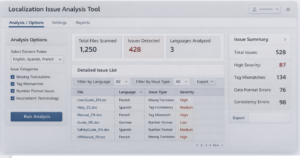
As the system matured, it was expanded into a UI, enabling:
-
On-demand analysis of large content sets
-
Configuration of issue categories and detection rules
-
Comparison of issue density across languages or releases
-
Export of results for review, reporting, or remediation planning
The current solution can be extended, allowing new issue types to be introduced as content strategies, languages, or formats evolve.